







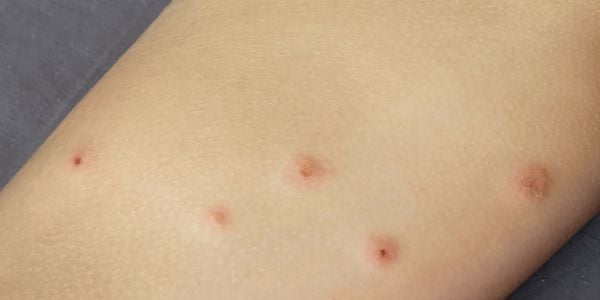
Impetigo is a common skin infection. It is very contagious and usually affects young children and babies. It definitely isn’t a nice-looking rash.
Classically, it begins with reddish sores on the face, especially around the nose and mouth. It may move to the trunk and limbs before spreading to the rest of the body. The sores burst and develop honey-coloured crusts.
How would my child acquire such an infection?
Let me relate a personal story:
My little daughter was playing netball and had a tumble. She grazed her knees. A week later, the knees had scabbed up nicely. She was sitting cross-legged in assembly when another child walked past. Their shoe caught her knee and removed the scab. A couple of days later, red spots began to appear on her face and legs. She thought she had been attacked by mosquitoes, but in fact a bacterium had entered through the exposed skin and caused the infection. The bacteria would either have been a Staphylococcus aureus or Streptococcus.
Her scenario was classic. The bacteria enter the skin in 2 main ways:
- A break in otherwise healthy skin because of something like a graze, cut or insect bite. We would call this primary Impetigo. This was exactly what happened to my daughter.
- Damaged skin due to a condition such as eczema or scabies. This is secondary Impetigo.
Besides the rash, what else can we expect with an Impetigo infection?
- Mild itching – the sores may be itchy or sore. This is why my daughter thought she had been bitten by mosquitoes.
- Swollen lymph nodes near the infected area. If the child has the rash around the mouth, then the lymph nodes under the jaw may swell.
- A fever is not likely to occur unless the infection becomes widespread.
Is Impetigo serious?
This is not usually a serious illness, but it is highly contagious. For this reason, proper antibiotic treatment is advisable because it does carry risks in certain situations:
- Babies under 1 year of age – These little ones have immature immune systems, which may not cope with a bacterial infection like Staphylococcus aureus or Streptococcus. The infection may quickly go from being a skin infection to something more systemic like septicaemia.
- There are different types of Impetigo. The first is non-bullous Impetigo. This is the most common type and generally doesn’t cause much harm besides the red sores and some discomfort. The second is bullous Impetigo. It begins with fluid-filled blisters that can be as large as 1 to 2 cm. They occur on the waist and neck or the arms and legs. This type can release toxins into the skin. Large blisters form and a condition known as Staphylococcal Scalded Skin Syndrome (SSSS) may occur. Ecthyma Impetigo is rare and usually only found in children who are immune-compromised. It does look like the non-bullous type initially, but if untreated, it can leave very deep holes in the skin. This is a progression in the illness if the Impetigo goes untreated.
- Untreated Impetigo has the potential to cause cellulitis (a deep skin infection), septicaemia (blood poisoning), scarlet fever or glomerulonephritis (a rare kidney problem that can occur after a streptococcal infection)
How is Impetigo treated?
Impetigo should get better within 2 to 3 weeks if it is untreated. The problem with this is that it is likely to spread to other parts of the body and other people in that time. The child also runs the risk of getting secondary infections.
The recommended treatment is:
- a course of antibiotics
- keep the child off school or away from other children for 48 hours after treatment has begun.
How can we distinguish between other rashes and Impetigo?
There are a few other rashes which could be confused with Impetigo. Remember that Impetigo often starts around the mouth area, so it may resemble:
- Cold sore/ fever blister (herpes simplex virus). These are usually isolated to the lips. Impetigo would often cause sores around the nose and possibly the torso, arms or legs.
- Hand, foot and mouth disease (Coxsackie) – Coxsackie, as the name describes, usually includes blisters or sores on the palms of the hands, soles of the feet and mouth. These typically appear before spreading to the rest of the body. The child is likely to be unwell and have a fever.
- Scabies – this is caused by mites which burrow under the skin and cause lines to appear. The rash itself would look a lot like Impetigo but is generally very itchy.
- Chickenpox (Varicella) – This generally starts on the chest, back and face. If your child has chickenpox, they are also likely to have a fever. The rash quickly spreads to the rest of the body. A child with chickenpox often suffers from fatigue and headaches, even before the rash appears. If your child has been immunised against chickenpox, then you should consider that the rash may be something else, like Impetigo.
Conclusion
We want children to be playing outside, doing sport and having fun with friends. The bumps, scrapes and scratches are all part and parcel of this. My advice to parents is to follow some simple rules if these mishaps do occur. Make sure that you clean scrapes, cuts, grazes or insect bites with mild soapy water. If your child suffers from eczema, then make sure you keep the skin in good condition by using the appropriate creams. This will ensure that the bugs don’t have a point of entry. Keep your child’s fingernails short and clean. Should your child be itchy, clean fingernails are less likely to introduce a bug into their skin. If your child develops recurrent Impetigo infections, your doctor may suggest a nasal swab. Some people carry staphylococcal or streptococcal bacteria in their noses. It may never cause a problem, but it has the potential to cause Impetigo. This is especially true if there is a break in the skin nearby. Impetigo is a common skin infection, but there are certainly steps that you can put in place to safeguard your little person.
References:
YOU MAY ALSO LIKE
Rubella, commonly known as German measles, is a contagious viral infection primarily affecting children and young adults.