







South Africa’s relationship landscape is shifting and the latest data tells a story that cannot be ignored. More marriages are ending and fewer are beginning, with women increasingly taking the lead in deciding when a relationship has run its course. This is not just a spike in numbers. It reflects a deeper social change around independence, expectations and what modern relationships look like in South Africa today.
Divorces Are Rising While Marriages Continue to Fall
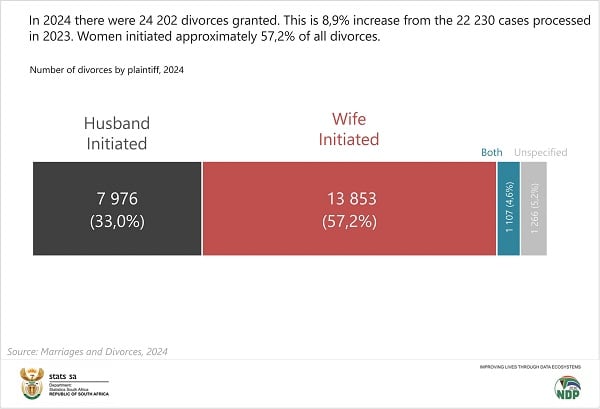
In 2024, South Africa recorded 24 202 divorces, marking an 8,9% increase from 22 230 in 2023. At the same time, marriage registrations declined to 102 373, down 2,6% year-on-year. Looking at the bigger picture, the shift becomes even more striking. Over the past decade, marriages have dropped by 40 906, a 28,5% decrease since 2015, pointing to a long-term change rather than a temporary dip. This tells a clear story. Fewer people are choosing marriage and more are choosing to leave it.
Women Are Leading Divorce Filings
One of the most defining trends in the data is who is initiating divorce.
In 2024:
- 57,2% of divorces were filed by women
- This trend has remained consistent over the years
That means more than half of all divorces are initiated by wives, highlighting a growing shift in agency and decision-making. This is not about relationships failing more often. It is about women having greater access to legal rights, financial independence and the confidence to leave situations that no longer serve them.
Where Divorce Is Happening Most in South Africa
Divorce filings are not evenly spread across the country. The highest number of women-led divorces came from:
- Gauteng: 4 289 cases (31,0%)
- Western Cape: 2 579 cases (18,6%)
- KwaZulu-Natal: 1 910 cases (13,8%)
Together, these provinces account for the majority of divorce activity, likely reflecting population density, urbanisation and access to legal systems.
Most Women Filing for Divorce Are Ending Their First Marriage
The data reveal that divorce is not primarily driven by serial marriages.
Among women filing in 2024:
- 89,1% were ending their first marriage
- 6,8% had been married twice
- 0,7% had been married more than three times
This reinforces that most divorces are not part of repeated patterns. They are often significant, life-altering decisions made after a long-term commitment.




ALSO READ: Explaining Divorce to Children: A Compassionate Guide for Parents
Age Trends Show Divorce Happens Later in Life
Divorce is no longer something that happens early in marriage alone. Key age insights include:
- The median age for women increased to 42 years
- The median age for men increased to 46 years
- The highest number of divorces occurred among women aged:
- 40–44 years (20,3%)
- 35–39 years (19,7%)
This suggests that many couples are spending years together before deciding to separate. Divorce is increasingly happening after shared history, children and financial ties have already been established.
Women Are Often Younger Than Their Spouses
The data also reflects traditional age dynamics:
- 70,7% of women who filed for divorce were younger than their husbands
- Only 16,5% were older than their spouses
This mirrors broader marriage patterns in South Africa, where men tend to be older than their partners.
Financial Independence Is Changing Relationship Decisions
Economic participation plays a powerful role in divorce trends.
In 2024:
- 10 804 women filing for divorce were employed (44,6%)
- Many worked in professional, technical and managerial roles
Financial independence gives women more freedom to make decisions about their lives. It removes one of the biggest barriers that historically kept people in unhappy or unhealthy marriages. This shift is not about marriage failing. It is about choice becoming more accessible.



Most Divorces Happen Within the First Decade
Marriage duration tells another important story.
In 2024:
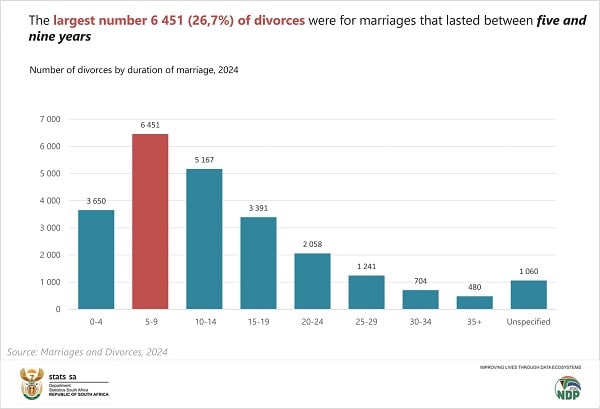
- 26,7% of divorces occurred in marriages lasting 5–9 years
- 21,3% occurred in marriages lasting 10–14 years
- 15,1% occurred in marriages under 5 years
Overall:
- 41,7% of divorces happened within the first 10 years
This suggests that the early and middle stages of marriage remain the most vulnerable periods, where expectations, pressures and life changes often collide.
What This Means for Modern Relationships in South Africa
When you look at all the data together, a clear pattern emerges.
South Africa is experiencing:
- Fewer marriages
- Later marriages
- More divorces initiated by women
This is not simply about relationships breaking down. It reflects a broader cultural shift where:
- Women have more autonomy
- Marriage is no longer seen as permanent at all costs
- Personal wellbeing is becoming a priority
For many women, divorce is no longer viewed as a failure. It is a decision to choose stability, safety or happiness over staying in a relationship that is no longer working.
The Bigger Picture
The rise in women-led divorces alongside declining marriage rates signals a redefining of commitment in South Africa. Marriage is no longer the default path. It is a choice and increasingly, so is staying in it. What we are seeing is not the collapse of relationships, but the evolution of them.
References
Statistics South Africa. Marriages and Divorces 2024 Statistical Release (P0307). https://www.statssa.gov.za/?p=19344
