


It’s always in the middle of the night, isn’t it? When your little one is burning up with fever, teething, or battling aches and pains, leaving you feeling desperate, unsure and alone. In those moments, knowing what medication to reach for and how to use it correctly can make all the difference.
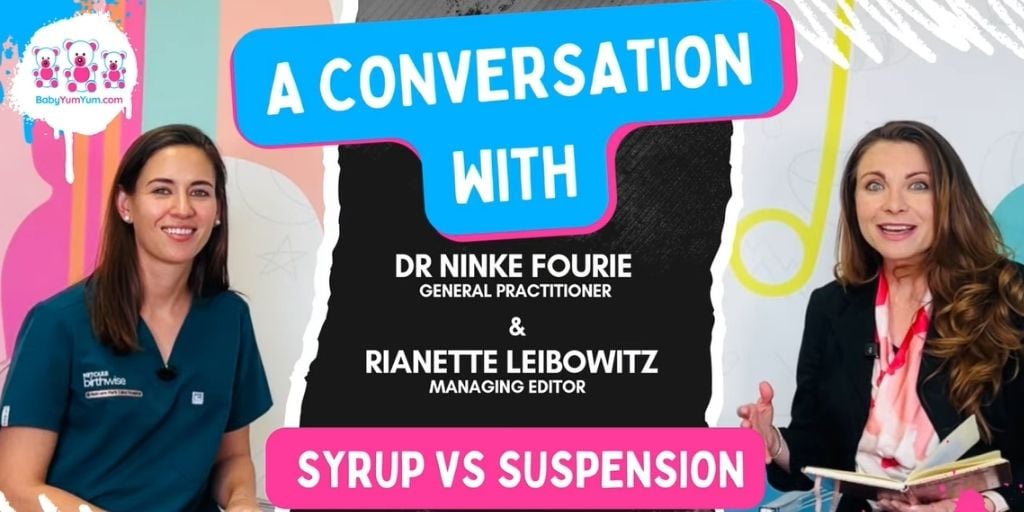
To help guide parents through these decisions, BabyYumYum’s Rianette Leibowitz spoke with Dr Ninke Fourie from Netcare Birthwise, an obstetric practice offering private-quality care at medical aid rates. Dr Fourie shares practical insights into the differences between syrup and suspension and gives guidelines on how to make informed choices when treating your child.
Q: Dr Fourie, before we dive into medication, please tell us more about Netcare Birthwise.
Dr Fourie: Netcare Birthwise is an obstetric practice focused on providing advanced medical care at medical aid rates. We aim to give families a private healthcare experience with minimal out-of-pocket costs. Our team includes GPs, nutritionists, midwives, and specialists who are all working together to support parents through every stage of their journey. We’ve also partnered with hospital providers and specialists to ensure seamless communication and continuity of care.
Q: Let’s talk about pain medication. What’s the difference between syrup and suspension?
Dr Fourie: The key difference lies in how the active ingredient is distributed.
- Syrup is like sugar dissolved in water. The active ingredient is fully dissolved, so every spoonful contains the same amount of medicine.
- Suspension contains tiny particles of the active ingredient that are suspended in the liquid. These can settle at the bottom if the bottle stands for a while. That’s why it’s so important to shake the bottle well before giving it to your child; otherwise, they might not get the correct dose.
Q: What exactly is an “active ingredient”?
Dr Fourie: The active ingredient is the part of the medicine that actually does the job. Whether it’s reducing fever, easing pain, or soothing teething discomfort. Everything else in the bottle is there to help deliver that ingredient effectively.
For example, when treating fever or pain, paracetamol is often the active ingredient. In syrup form, every spoonful will contain the same amount of paracetamol. In suspension, it’s also accurate, but only if you’ve shaken the bottle properly to ensure even distribution.
Q: How do I know what dosage is suitable for my child?
Dr Fourie: Always check the medicine packaging or insert the leaflet, or follow your healthcare provider’s instructions. Dosage for children is based on age and weight, not the specific ailment. Whether it’s teething or fever, paracetamol is dosed according to those two factors. That’s why it’s so important to read the label carefully.
Q: Does dosage differ between syrup and suspension?
Dr Fourie: Not really. For younger children, syrup is often preferred because it tastes better and is easier to swallow. As children grow older, suspensions can offer a more concentrated dose in a smaller volume. But the key is still to follow the dosage guidelines based on age and weight, and always shake suspensions well before use.
Q: How long does it take for pain relief to kick in?
Dr Fourie: With paracetamol-based medication, you can expect relief to begin within 30 minutes of giving the correct dose. The effect usually lasts four to six hours, which is why you can dose every four to six hours, but never exceed the recommended total for 24 hours. If symptoms persist beyond two days, it’s time to seek medical advice.
Q: Is there a difference in taste or smell between syrup and suspension?
Dr Fourie: Yes. Syrups are generally smoother and sweeter, making them easier for younger children to take. Suspensions can sometimes be chalky or have bits that are harder to swallow. Fortunately, pharmaceutical companies have made great strides in improving taste and smell with added flavourings and colourants, so most child-friendly medications are quite palatable.
Q: What about storage and safety?
Dr Fourie: Always check the expiry date before giving any medication. If the medicine looks or smells different from when you bought it, discard it and get a new bottle. Suspensions must be shaken well before use to ensure the active ingredient is evenly distributed. And of course, store all medicines safely out of reach of children.




Q: Any final advice for parents?
Dr Fourie: Stay informed. Choose trusted sources for your information, and follow your healthcare provider’s advice. If you’re ever unsure, refer to the medicine leaflet, because it usually explains dosage and safety clearly. And if symptoms persist or worsen, don’t hesitate to seek medical attention.
Rianette’s closing thoughts: Besides understanding the difference between syrup and suspension, remember that parenting is a journey best travelled with support, love and patience. You’re never alone, and BabyYumYum is here to walk with you. Let us know: what’s been your biggest challenge when managing pain, teething, or fevers in your little ones?
YOU MAY ALSO LIKE
Find out when it’s safe to treat your child’s fever at home and when a doctor’s visit is necessary. Simple steps for a speedy recovery.
