




A survey from the Australian Dental Association out this week shows about three in four children never floss their teeth, or have adults do it for them. Many of the survey respondents thought it wasn’t worthwhile for baby teeth.
As anyone who cares for kids knows, it can be hard enough to get them to brush twice daily, let alone floss.
So how do you actually get kids to floss? Why do they need to anyway?
Do kids really need to floss?
Flossing can reach between the teeth where toothbrushes can’t. It removes the soft food debris and biofilm, a slimy layer on teeth that harbours microbes, and so reduces the risk of dental decay and gum disease.
So flossing is essential as soon as children’s teeth erupt and are in contact with the next one. This is typically at the age of six to eight months when the lower front teeth start to emerge through their gums.
But they’re just baby teeth, right?
You may be thinking flossing is not worth the time or trouble, especially for younger children who’ll lose their baby teeth in a few years anyway.
However, baby teeth play a vital role in how children’s jaw bones develop and their face appears. And losing baby teeth early – due to the dental decay that can arise from not flossing – can have several effects.
As a child, it can change their speech and appearance. These can affect a child’s self-esteem and impact their wellbeing, depending on their age.
Losing baby teeth early can also affect them as a teenager or adult. Baby teeth act as a guide to where permanent teeth should erupt so losing them early can lead to crowding of teeth, needing orthodontic treatment (braces). In fact, premature loss of baby teeth can increase the risk of “malocclusion” or problems in the position of permanent teeth by more than 2.5 times.





Cleaning between the teeth is also vital for teens to reduce the risk of gingivitis (inflammation of the gums). This is very common in this age group due to changes in hormone levels.
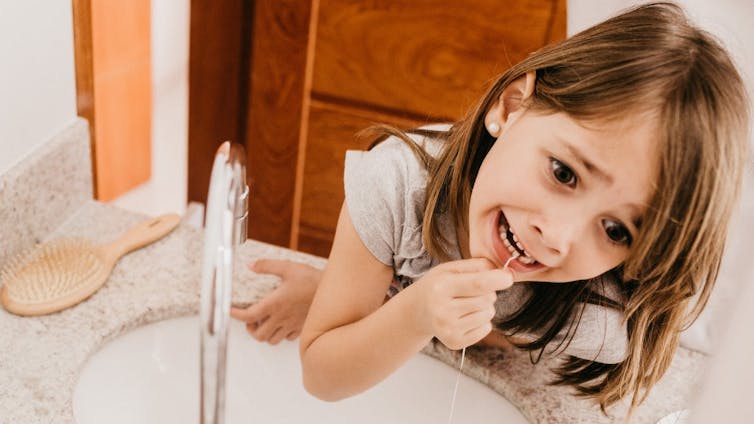
Yes, it can be challenging
Setting up a regular flossing routine may be challenging for many families. It’s one more thing to squeeze into the early morning rush to get to school or work. It can be hard to motivate tired children to floss at the end of the day too.
The technique itself also needs a level of manual dexterity for the kids themselves or for the parents who floss younger kids’ teeth.
You or your kids may have some form of dental anxiety due to previous negative experiences with dental visits. This may affect dental hygiene, or your likelihood to floss.
All of these factors can lead to lack of motivation or reluctance to floss, and so increases the risk of dental decay and gum disease in children.
But there are ways to help you and your kids develop and stick to a flossing regime.
OK, you’ve convinced me. What next?
First, gather your equipment.
Interdental brushes look like mini bottle brushes. These are more effective for larger spaces between adjacent teeth, or if your child has braces.
Floss or floss picks are only effective for areas with smaller or no spaces between adjacent teeth. Kid-friendly designs, such as animal-shaped and colourful floss and floss picks, can be an excellent option to make this routine more enjoyable. Flavoured floss, or floss that smells like fruit or chocolate can be appealing. Involving kids in the choice of floss or floss picks can boost their motivation to floss.
Alternatively, a waterjet flosser can make cleaning between the teeth more engaging. It’s as effective as regular dental floss.
For toddlers and preschoolers, using rewards and positive reinforcements, such as sticker charts or gold stars, can keep kids motivated to floss. So stock up.
Then choose your timing. Flossing is best done once a day, either in the morning or before bedtime. That’s because flossing can effectively remove biofilm between the teeth for 24 hours. You can floss before or after brushing.
Parents will need to brush and floss the teeth of infants and children up to five years old, until the children develop their own manual dexterity.
For infants, it’s easier if one adult holds them upright or sits them on their lap while the other does the flossing. For toddlers and preschoolers it may be easier to floss if they are sitting on the toilet, or standing at the basin with their head tilted back.
Last of all, lead by example. Kids with parents who regularly floss tend to pick up the routine quickly.
Any more tips?
Flossing is only one part of preventing tooth decay and dental diseases, such as gum disease. It’s also important for children to:
avoid snacking on food with a high sugar content
choose plain water over fruit juices or fizzy drinks
avoid falling asleep with a feeding bottle containing milk, fruit juice or sugary liquids
avoid using a dummy dipped in sugary liquids or honey
clean their tongue while brushing their teeth
see a dentist or oral health professional well before their first tooth erupts so they can get used to the idea of a dental appointment.


Dileep Sharma, Professor and Head of Discipline – Oral Health, University of Newcastle
This article is republished from The Conversation under a Creative Commons license. Read the original article.
ALSO READ: 10 Ways to Care for Your Child’s Milk Teeth