



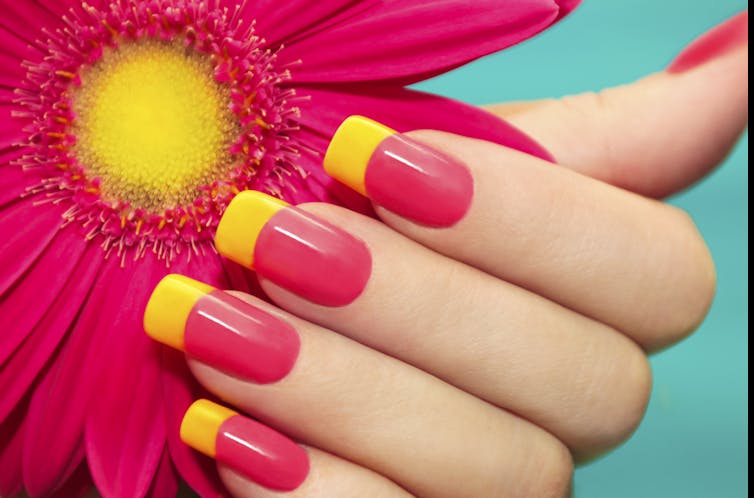
From Kylie Jenner and Rihanna to Ariana Grande and Cardi B, celebrities are sporting long, acrylics – often heavily embellished with nail art – as an expression of their style. Nail fashion is now a booming industry with gel manicures and acrylic nails among the most popular current trends. While manicures might feel like self-care, they can ruin healthy natural nails – and might even cause unexpected health problems in a small proportion of people who get them.
For example, the nail glue used to attach acrylics to the natural nail is typically a mixture of alcohol, cyanoacrylate and photo-bonded methacrylate, with other ingredients including formaldehyde, which is a known carcinogen.
The chemicals in the nail adhesives can cause skin irritation and dermatitis.
Nail glue burns are also widely reported. In some cases, nail glue spilled on clothing has caused injury by burning through the fabric and damaging the skin beneath, which can then become infected.
Prolonged wearing of gels and acrylics can also lead to pseudo-psoriatic nails, where extra-skin – known as hyperkeratosis – growing under the nail resembles the red and crusty appearance of psoriasis. Many manicure enthusiasts with pseudo-psoriatic nails test positive for allergy to methyl methacrylate.
In some cases the allergy can be so severe that it causes the permanent loss of fingernails. Others suffer from peripheral neuropathy – tingling or numbness in fingers – sometimes permanently.
An unlikely cause of skin cancer?
There are many factors that contribute to cancer risk, including age, skin type, previous exposure and family history; however, there are cases of skin cancer where UV nail lamp are reported to have played a role.
Gel nails are cured using special dryers that emit ultra-violet light in the form of UVA, which hardens the gel converting it to stiff polymers. Since most people have their nails done every few weeks – and it takes approximately ten minutes to harden – that significantly increases UVA exposure. The back of the hands may be one of the most UV-resistant parts of the body but it’s also unprotected by clothing – and one of the most common places people forget to apply suncream. If sunscreen is applied to hands then it’s often washed off regularly without being reapplied.
If you’re a fan of gels, reduce your risk of UV exposure by applying a high factor sunscreen 30 mins before the appointment and wear dark, fingerless gloves during the manicure.
ALSO READ: 5 tips to protect your family’s skin this summer





Weak, brittle, dry nails
Removal of gels and acrylics often peels or shaves away fragments of the nail plate. Even the most painstaking removal can damage the nail’s keratin layers, which can weaken the nail, cause it to become brittle and the damage can make nails appear white (a condition known as pseudoleukonychia). Many of the chemicals used for removal, including acetone for gel nails, can also dry out the nail and surrounding skin – and be absorbed into the blood stream.
The removal process for both gel and acrylic manicures can wear down natural nails, which can be overfiled, causing stripes running across the ends of the nails, as well as changes and damage to the capillaries underneath.
Removing the nails can also cause traumatic onycholysis, where the nail is pulled away from the bed underneath, giving a classic rollercoaster appearance at the join between the nail and the underlying bed. This can open up the barrier that protects the internal body from the outside world, particularly at the edges on either side of the nail, when they become infected this is known as paronychia.
Leaving false nails on for too long can cause moisture to build up underneath the nail, creating an ideal environment for onychomycosis – the growth of fungus. Often, the changes to the appearance of the natural nail caused by a fungal infection are hidden by the acrylic, so infections can progress without being noticed.
Bacterial breeding ground
Even traditional nail varnish isn’t without risk. It can alter pulse oximeter readings, which measure how much oxygen your blood is carrying. Thankfully, most of the time these are not altered to a clinically significant level but gels, acrylics and varnish are banned in clinical settings because the spaces under nails and chips on polish are a breeding ground for bacteria which can be passed between staff and patients.
If you enjoy manicures then it might be a better idea to forgo the gels and acrylics and concentrate on caring for your natural nails, leaving them visible so you can notice any changes to their appearance that might indicate health issues, such as fungal infections – and even heart disease.
Adam Taylor, Professor and Director of the Clinical Anatomy Learning Centre, Lancaster University
This article is republished from The Conversation under a Creative Commons license. Read the original article.