








For many South African families, these first foods are not expensive commercial products. They are familiar foods that have been prepared in our homes and communities for generations, including soft pap, samp, potatoes, pumpkin and leafy vegetables such as morogo.
Traditional foods can have an important place in a baby’s diet. The important question is not whether a food is traditional or modern, but how it is prepared, what it is served with, and whether it is suitable for the baby’s age and development.
When should complementary foods start?
Complementary feeding generally starts at around six months of age. At this stage, breastmilk alone no longer meets all the nutritional needs of a growing baby.
Complementary foods are added to breastmilk rather than immediately replacing it. Breastfeeding can continue while the baby learns to eat different foods, tastes and textures. The World Health Organization recommends continued breastfeeding alongside complementary foods to two years and beyond.
The introduction of food is also a learning period. Babies need time to learn how to move food around their mouths, swallow different textures and discover new tastes.
The focus should therefore be on gradually building healthy eating habits rather than expecting a baby to eat large portions immediately.
Soft pap: a familiar South African first food
For many South African families, soft maize-meal porridge is a natural place to start. A study conducted among mothers in a township in Tshwane found that maize-meal soft porridge was the most commonly reported first complementary food.
There is nothing wrong with using a familiar staple such as pap. The important point is that pap should not become the baby’s only food.
Pap can provide energy and, when fortified maize meal is used, can contribute important nutrients. As complementary feeding progresses, it can be combined with other foods to improve the nutritional value of the meal.
For example, soft pap can be served with:
- Mashed beans
- Mashed egg
- Mashed pumpkin
- Appropriately prepared chicken
- Smooth peanut butter, when safely introduced
The aim is to provide variety rather than relying mainly on one food.
This is particularly important because South African research has found that grains, roots and tubers are commonly eaten by young infants, while some other food groups are eaten less often. A varied diet helps babies receive a wider range of nutrients.



What about samp?
Samp is another familiar South African staple that can form part of a baby’s diet when prepared appropriately.
For a young baby, samp should not be given as hard or whole pieces. It should be cooked thoroughly until very soft and then mashed to a texture that the baby can safely manage.
It can be combined with foods such as beans, vegetables or appropriately prepared chicken.
As the baby develops better eating skills, the texture of foods can gradually become thicker and more textured. Babies should not remain on thin, watery or completely smooth foods for longer than necessary.
The aim is to help the baby gradually progress towards eating a wider range of family foods safely.
Morogo: bringing traditional vegetables to the baby’s plate
Morogo and other dark-green leafy vegetables are traditional foods that can contribute variety and nutrients to a baby’s diet.
For a baby, leafy vegetables should be washed properly and cooked until soft. They can then be finely chopped, mashed or blended according to the baby’s developmental stage.
Morogo does not need to be served on its own. It can be combined with soft pap and beans, mashed potato and egg, or another suitable combination of foods.



This is what balanced complementary feeding looks like: different foods working together rather than expecting one food to provide everything.
Don’t forget protein
One of the easiest mistakes to make when introducing traditional foods is to focus heavily on starch.
Pap, samp and potatoes can provide valuable energy, but babies also need protein and other nutrients for growth and development.
Affordable protein-rich foods can include:
- Eggs
- Beans
- Lentils
- Chicken
- Fish and pilchards
- Plain yoghurt
- Other suitable animal-source foods
South African research has shown that foods such as grains, roots and tubers may make up a large part of young children’s diets, while animal-source foods may be consumed less often.
This is why adding foods such as eggs, beans, fish or chicken can make a traditional meal more nutritionally complete.
For example:
Soft pap + mashed beans + pumpkin
Or
Mashed potato + mashed egg + morogo
Or
Soft samp + beans + soft vegetables
These are simple meals made from foods that many families already know.
Potatoes, pumpkin and other affordable foods
Traditional complementary feeding does not have to be expensive.
Potatoes, pumpkin and other locally available vegetables can be cooked until soft and then mashed or blended according to the baby’s developmental stage.
These foods can easily be combined with a protein source to create a more balanced meal.
For example:
Mashed potato + mashed egg + pumpkin
Or
Soft pap + beans + morogo
The aim is to use foods that families can realistically access while still providing variety and nutritional value.
Research from KwaZulu-Natal found that caregivers’ food choices were influenced by factors such as affordability, availability, convenience, family advice and cultural beliefs. These factors matter because nutrition advice needs to work in real homes, not only on paper.
There is little value in recommending foods that families cannot afford or easily access.
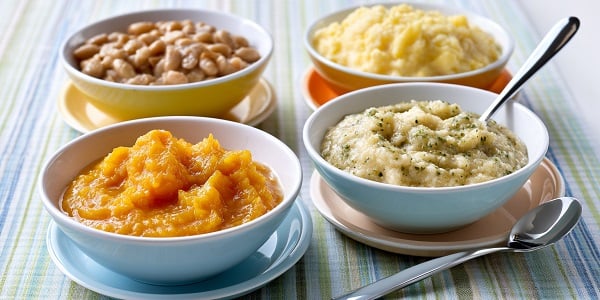
Getting the texture right
Texture is just as important as the food itself.
When a baby first starts eating, foods should be soft and prepared according to the baby’s developmental abilities.
A fork can be used to mash soft foods. A blender can also be used when necessary.
If blending makes the food too thick, a small amount of breastmilk or prepared infant formula can be used to adjust the consistency.
However, there is no need to keep every food completely smooth or watery. As the baby’s eating skills develop, gradually offer thicker and more textured foods.
The texture should always be appropriate for the baby’s developmental stage and prepared in a way that reduces choking risk.
Respecting tradition while using nutrition science
Introducing complementary foods can sometimes bring different generations together around the same table. A grandmother may have advice based on what she fed her children, while a healthcare professional may provide advice based on current research.
These conversations do not have to become a battle between “traditional” and “modern.”
Our traditional foods are valuable. Nutrition science can help us understand how to prepare and combine them in ways that meet the needs of today’s babies.
Research in South Africa has shown that family members, cultural beliefs and practical considerations can strongly influence complementary-feeding decisions.
Instead of asking, “Is this traditional food good or bad?”, a better question is:
“How can we prepare this familiar food safely and make the meal more nutritious for the baby?”
That approach allows families to keep their food culture while also supporting healthy growth and development.
What should parents remember?
When introducing complementary foods:
- Start complementary foods at around six months.
- Continue breastfeeding alongside complementary feeding.
- Offer a variety of food groups.
- Do not rely on pap, samp or another starch alone.
- Include protein-rich foods such as eggs, beans, fish, chicken or lentils.
- Include vegetables and fruit regularly.
- Gradually increase the thickness and texture of foods as the baby develops.
- Prepare and handle food safely.
- Follow your baby’s hunger and fullness cues rather than forcing food.
Research from Limpopo also shows that caregivers may introduce foods early because they believe the baby is hungry, crying or not satisfied with breastmilk. This highlights why families need clear, practical information about normal infant feeding and the appropriate timing of complementary foods.
Keeping our food heritage alive
Our babies do not need expensive foods to eat well.
Sometimes, some of the most nutritious and meaningful foods are already in the family kitchen.
Soft pap, samp, morogo, pumpkin, potatoes and other familiar foods can all have a place in complementary feeding when they are prepared safely, offered in an appropriate texture and combined with other nutritious foods.
Heritage Month gives us a beautiful opportunity to celebrate the foods that connect us to our families and communities while also making sure our children receive the nutrition they need.
We do not have to choose between tradition and modern nutrition science.
We can preserve our food heritage, make informed choices and give our babies the best of both worlds.
Traditional food. Family heritage. Evidence-based nutrition. Healthy beginnings.
References
- World Health Organization. (2023). WHO guideline for complementary feeding of infants and young children 6–23 months of age. Geneva: World Health Organization.
- Erasmus, C.R., Pillay, T. & Siwela, M. (2023). Factors affecting the choices made by primary caregivers during the complementary feeding transition period, KwaZulu-Natal, South Africa. South African Journal of Clinical Nutrition, 36(1), 1–7.
3. Manafe, M., Mokone, S.M. & Ncube, L.J. (2022). Complementary feeding practices of mothers of children aged 0 to 12 months in a township in Tshwane, Gauteng Province. Gender and Behaviour.
4. Sayed, N. & Schönfeldt, H.C. (2022). The use of linear programming to determine whether breastfed infants can achieve a nutritionally adequate complementary feeding diet: a case study of 6–11-month-old infants from KwaMashu, KwaZulu-Natal, South Africa. South African Journal of Clinical Nutrition.
5. Mukwevho, T., Smuts, C.M., Asare, H. & Faber, M. (2023). Energy and nutrient contribution of different food groups to the dietary intake of 6- to <9-month-old infants in a low socioeconomic community in North West Province, South Africa. South African Journal of Clinical Nutrition, 36(3), 126–135.
6. Mbhenyane, X.G., Mandiwana, T.C., Mbhatsani, H.V., Mabapa, N.S., Mushaphi, L.F. & Tambe, B.A. (2023). Breastfeeding and complementary feeding practices of mothers exposed to the Baby-Friendly Hospital Initiative in Limpopo Province. South African Journal of Child Health, 17(2).