







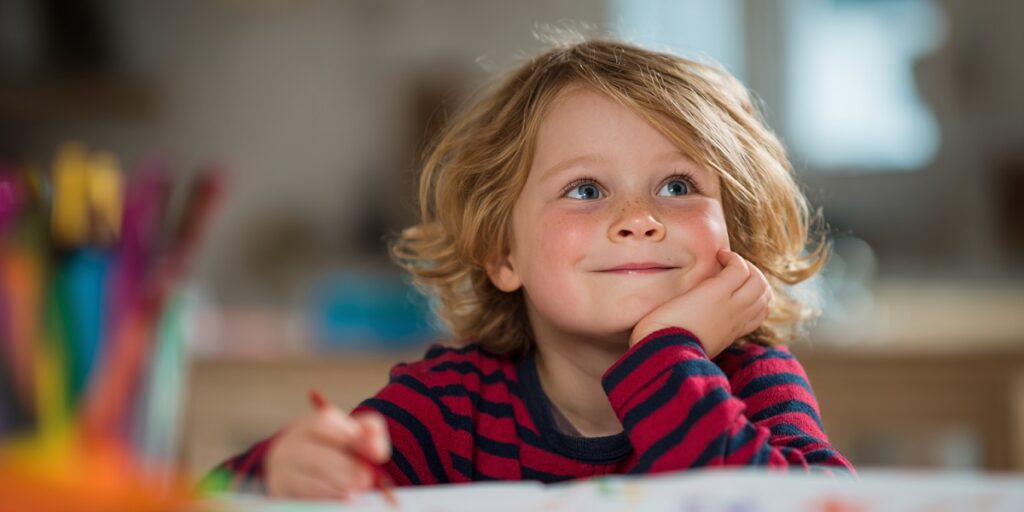
There’s a moment most parents know well: you’ve explained something to your child three times, slowly and carefully (maybe even with hand gestures) and then they look at you with complete sincerity and ask the same question again. Before you question your sanity (or theirs), it helps to understand what’s actually happening inside that head of theirs.
Learning isn’t a light switch where, in one magical moment, confusion becomes clarity and suddenly everything makes sense. Learning happens in the moment that came before the click – in the repeated attempts, the wrong answers, the slow and unglamorous process of the brain quietly building the pathways that made that moment possible. The click doesn’t create the learning; the learning creates the click.
We’ve all heard the phrase “children are like sponges.” What we mean when we say it is that children absorb everything effortlessly and that learning, for them, is almost accidental. The world pours itself into them and they soak it up without even trying.
Yes, there is truth in it. Young children do pick up language, social cues, and habits at a rate that leaves most adults quietly envious. The sponge comparison, however, also carries an assumption that children are passive in this process — that learning just happens to them.
Children’s brains are far more active than that – and far more selective.
When a child encounters something new, their brain doesn’t simply file it away. It goes looking for somewhere to put it – (something already known) and tries to hook the new information onto that. Think of it as Velcro for your brain: the more hooks that are already there, the more likely something new sticks.
This is why children learn the word “dog” and then confidently point to every four-legged animal and call it one. They’re not being silly, they’re just taking what they know and testing it against the world.
This is exactly why context, experience and prior knowledge matter so much. Those connections aren’t just helpful; they’re the scaffolding that holds everything else up.
Repetition is how the brain builds highways
Donald Hebb, known as the father of neuropsychology, said:
‘When neurons fire together, they wire together.’
Every time a child practises a skill, whether it’s reading a word, tying a shoelace, or solving a sum, the brain is strengthening the physical pathway that holds that skill. The more times that pathway is activated, the faster and more automatic the process becomes.



This is why a child who is learning to read doesn’t just need to see a word once. They might need to see it twenty times, in different contexts, before their brain builds a fast enough highway to retrieve it without effort.
What looks like forgetting is often just a pathway that hasn’t been travelled enough yet. But with time and repetition, the road becomes a superhighway.
ALSO READ: Baby developmental milestones: birth to 24 months
Emotion is not separate from learning — it IS learning
Here’s something teachers and parents often underestimate: a child cannot learn well if they don’t feel safe. The brain’s threat-detection system, known as the amygdala, sits right next door to the hippocampus, which is responsible for forming memories. When a child is anxious, embarrassed, frightened, or overwhelmed, the amygdala essentially takes over and learning shuts down.
On the flip side, when a child feels connected, curious, and safe to make mistakes, their brain is flooded with dopamine — the chemical that essentially tells the brain: this matters, pay attention, remember this.
This is why a child who loves their teacher often seems to learn more easily. And why a child who is afraid of getting things wrong often seems to learn less. The content hasn’t changed, but the emotional climate has.
The brain is not fixed; it’s a work in progress
For a long time, we believed the brain was essentially fixed — that you were born with a certain amount of intelligence and that was that. Neuroscience has since shown us something far more interesting. The brain is plastic – malleable, shapeable, rewirable at any age. This is what scientists call neuroplasticity and it changes everything about how we think about learning.
Every time your child encounters a challenge, works through confusion, or makes a mistake and tries again, their brain is physically responding. New neural connections are forming while existing ones are strengthening. The brain that comes out the other side of a hard moment is different from the one that went in.



This means that struggle is not a sign that something is wrong. It’s a sign that something is happening. The discomfort your child feels when something is hard – that’s the feeling of a brain being built.
So what does this mean for us, as parents?
The most powerful learning environment we can create for our children isn’t necessarily the one with the most worksheets or the most structured programmes. It’s one where they feel safe to try, free to fail, encouraged to ask why and are met with patience when the same question comes around for the fourth time.
The brain learns when it feels like it belongs and most of the time that starts with us.