



I wrap up my workday and head for home, making a quick stop to grab the supplies my sixth grader needs for a project due this week and some ingredients for a quick dinner.
Once home, I check the sixth grader’s school website and discover a missing assignment. Bringing this up sparks a minor meltdown. I summon the emotional energy to help her calm down and problem-solve. My husband arrives home with our high schooler, who’s discouraged by something that happened at soccer practice. We’ll have to process that later.
Around the dinner table, we realize that both kids have sports practices Thursday, on opposite ends of town, at the same time as a mandatory parent meeting at school. And now I’m ready for my own meltdown.
On this particular evening, my family wasn’t navigating anything unique or especially catastrophic. Scenes like this play out nightly in homes across the United States. In fact, my family’s circumstances offer the protections of multiple forms of privilege. Certainly others have more difficult circumstances.
Why is it still so hard?
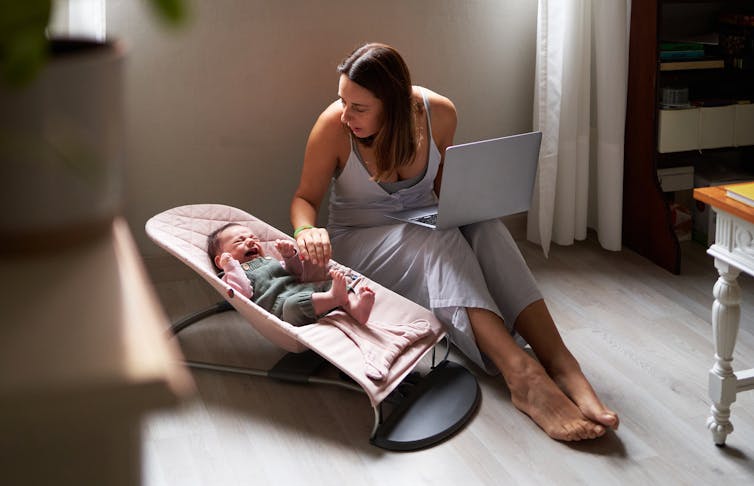
For a long time, I felt ashamed for being overwhelmed by parenthood. How do others seem to have it all together? Of course, the highlight reel of social media only fueled this comparison game. I often felt that I was falling short, missing some hack that others had found for not feeling constantly exhausted.
Abraham Gonzalez Fernandez/Moment via Getty Images
The reality is I’m far from alone in experiencing what social scientists term parenting stress. Defined as the negative psychological reaction to a mismatch between the demands of parenting and the resources available, parenting stress has become increasingly prevalent over the past five decades. In the wake of the COVID-19 pandemic, nearly half of all parents in the U.S. said their stress was completely overwhelming on most days.
Stress like this has an impact: Parents who experience high levels of parenting stress have decreased mental health and feel less close with their children.
I began researching parental stress and well-being when, several years after becoming a parent, I left my job as a social worker and entered a Ph.D. program. Through this process, I learned something that changed my perspective entirely: Parents today experience such high levels of stress because people have never traditionally raised children in isolation. And yet, we are more isolated than ever.
It clicked: Parents don’t need to do more or try harder. We need connection. We don’t need more social media posts on the “top three ways to keep your family organized.” We need a paradigm shift.
Maskot/DigitalVision via Getty Images
The myth of family self-reliance
Throughout human history, people primarily lived in multigenerational, multifamily arrangements. Out of necessity, our hunter-gatherer ancestors relied upon their clan-mates to help meet the needs of their families, including child-rearing. Research over time and across cultures suggests that parents are psychologically primed to raise children in community – not in isolated nuclear family units.
Anthropologists use the term alloparents – derived from the Greek “allo,” meaning “other” – to describe nonparent adults who provide care alongside that provided by parents.





Research suggests that alloparenting contributes to child well-being and even child survival in populations with high rates of child mortality. A 2021 study of a present-day foraging population in the Philippines found that alloparents provided an astounding three-quarters of the care for infants and an even greater proportion of the care for children ages 2 to 6.
In contrast, the ideal of the nuclear family is incredibly recent. It developed with industrialization, peaking in the 1950s and 1960s. Despite the significant changes in family structure – such as an increase in single-parent households – since that period, the paragon of the self-reliant nuclear family persists.
And yet, support from others is a key factor in family resilience. The familiar adage “It takes a village to raise a child” is, in fact, bolstered by social support research among parents in general, as well as those of children with special needs.
Parenting with collective care
Social support, while often viewed as a singular phenomenon, is actually a constellation of actions, each with its own unique function. Social scientists specify at least three types of support:
- Tangible: Material or financial resources or assistance
- Emotional: Expressions of care, empathy and love
- Informational: Provision of information, advice or guidance
Different parenting challenges call for different types of support. When my husband and I realized we had three commitments in a single evening, we didn’t need advice on managing our family’s calendar; we needed someone to take our kid to practice – that’s tangible support. When my tween was blowing up over homework, I didn’t need someone to bring us dinner; I needed to remember what I learned from a book on parenting adolescent girls – that’s informational support.
To move away from the myth of family self-reliance and back toward an ideal of collective care would take a paradigm shift, requiring intervention at every level, from federal to state to family. A 2024 Surgeon General’s Advisory on parenting stress called it an urgent public health issue and provided recommendations for government leaders, service systems and communities. Systemic strategies like providing access to high-quality mental health care, expanding programs like Head Start that support parents and caregivers, and investing in social infrastructure like public libraries and parks could all help reduce parenting stress in the U.S.
VIJ/iStock via Getty Images Plus
Personal steps toward a paradigm shift
Parenting stress is not a problem that can be solved solely by the individuals experiencing it. But here are five ways you can start making the shift toward collective care in your own life:
- Take stock of your network. Assess not only in terms of the number of supporters, but what types of support they offer. Do you have plenty of people to talk to, but no one who would bring you a meal or give your kid a ride? Identify gaps and consider ways to round out your “village.”
- Start small. Introduce yourself to your retired neighbor. Sit next to another parent at your kid’s sporting event. Talk to the babysitter you regularly see at the playground. Supportive relationships don’t just happen; they are grown.
- Offer help to others. While it seems counterintuitive, people who give support to others experience greater well-being and even longevity compared with those who don’t. Helping others also creates the opportunity for reciprocity. Those you support may be more likely to return the favor in the future.
- Normalize asking for help and taking it when offered. For many people, asking for support is hard. It requires dropping the facade and letting people in on your struggles. However, people are often more willing to help than you might assume. Further, allowing others to help you gives them permission to voice their own needs in the future.
- Consider your caregiving expectations. The way others care for your children may not mirror your way entirely. Consider what are nonnegotiable practices for your family – such as limits on screen time – and what is worth loosening up on – like veggies at every meal – if it means you have more alloparents helping you out.
None of these suggestions are easy. They take time, vulnerability and courage. In our society of rugged individualism and nuclear family self-reliance, parenting through a lens of collective care is downright countercultural. But perhaps it’s closer to how we, as humans, have raised children throughout the millennia.
Elizabeth Sharda, Associate Professor of Social Work, Hope College
This article is republished from The Conversation under a Creative Commons license. Read the original article.