







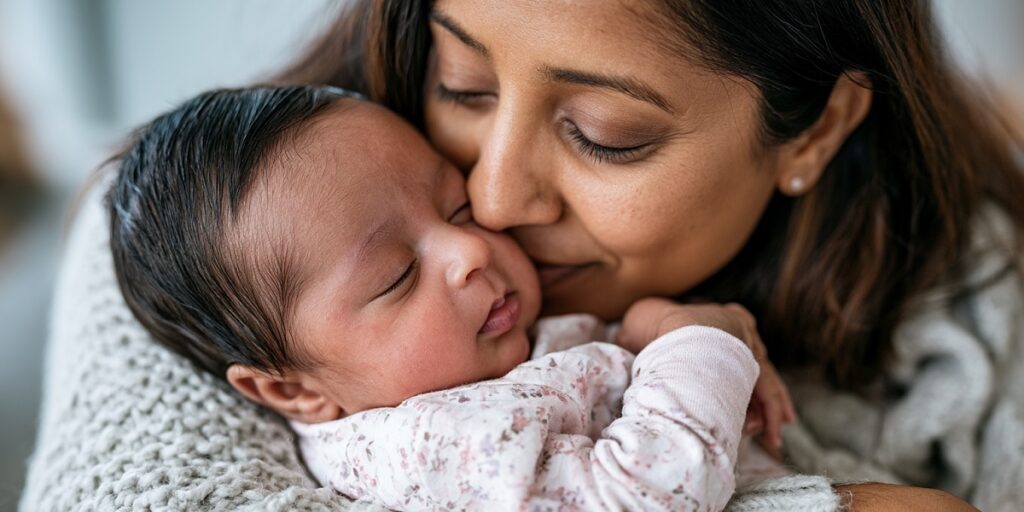
In honour of Mental Illness Awareness Month, we’re shining a light on one of parenthood’s most under-talked-about topics and a surprisingly powerful tool that might just help.
You’ve prepared the nursery, washed the tiny onesies three times, googled “how to swaddle” more times than you’d like to admit. But nobody quite prepares you for the emotional rollercoaster that can arrive alongside your new baby and nobody tells you that feeling overwhelmed, disconnected, or flat-out terrified doesn’t make you a bad parent. It makes you human.
JULY is Mental Illness Awareness Month, and this year we’re starting a long overdue conversation: maternal mental health. Not just the “baby blues” everyone mentions offhand, but the full spectrum of emotional challenges that can affect new and expectant parents and what you can actually do about them.
It’s Not Just “New Mum Nerves”
Maternal mental health challenges are not a sign of weakness and they’re far more common than most people realise. The excitement of expecting a baby is real, but so are the anxiety, the self-doubt, and the hormonal chaos.
Risk factors are wide-ranging and deeply human. A family history of mental illness, a previous miscarriage, financial stress, limited support, or even just being younger than 18 or older than 35 can all increase vulnerability. And for dads and partners? The pressure of suddenly becoming the sole income earner, or simply not knowing how to help, is its own very real source of stress.
The key takeaway: mental health challenges during pregnancy and after birth can affect “anyone”, regardless of how “prepared” or “together” they appear.
Know the Difference: Baby Blues vs. Something More
Here’s a quick breakdown of what’s what, because these terms get used interchangeably far too often:
The Baby Blues hit most new mums around days three to five after birth. You might feel tearful, irritable, and emotionally wobbly and that’s actually normal. Your hormones are doing a complete nosedive while your body recovers from birth and adjusts to breastfeeding. The baby blues typically resolve within a week or two with rest, support, and a lot of grace.
ALSO READ: Mental Wellbeing After Pregnancy: Baby Blues, Postpartum Depression and Real Support for SA Moms
Antenatal Depression can show up as early as 10 to12 weeks into pregnancy, as pregnancy hormones surge. Many women feel guilty for not “glowing” the way they expected, but struggling emotionally during pregnancy is more common than the Instagram grid would have you believe.
Postnatal Depression (PND) is more than sadness. It’s a persistent low mood that can make even the basics of baby care feel like climbing a mountain. Mums with PND may feel disconnected from their baby, exhausted beyond normal new-parent tired, and unable to find joy in moments that “should” feel special.


Postnatal Psychosis is rare but serious; a sudden onset of confusion, hallucinations, or erratic behaviour, usually within the first two to three weeks after birth. This requires “immediate” medical attention. No waiting to see if it passes.
If baby blues symptoms persist beyond two weeks, please reach out to your healthcare provider. You don’t have to wait until things feel unbearable.
The Role of Hormones (And Why They Matter More Than You Think)
Three hormones worth knowing:
- Oxytocin your love and bonding hormone. It’s released during labour, breastfeeding, skin-to-skin contact, and yes, massage. It deepens connection and eases anxiety.
- Dopamine your feel-good hormone. It creates a sense of wellbeing and joy. When dopamine levels dip, so does your emotional resilience.
- Cortisol your stress hormone. Elevated cortisol over time is linked to anxiety, poor sleep, and depression in both parents and babies.
Understanding these isn’t about going down a science rabbit hole; it’s about recognising that what you’re feeling has a biological basis. Your brain and body are going through something enormous.
So, Where Does Infant Massage Come In?
This is where things get beautifully practical. Research consistently shows that parents who massage their babies regularly experience measurable reductions in anxiety, depressive symptoms, and stress hormones — while their self-confidence and emotional connection to their baby improve significantly.
For a mum experiencing PND, the impact is even more targeted. Depression can quietly erode touch and engagement; a mum may find herself going through the motions of care (feeding, bathing, changing) without the warm, connected moments in between. Infant massage creates a structured, intentional space to ‘just be’ with your baby. Skin to skin. Eye to eye. Breath to breath.
Here’s what the research shows
- Cortisol drops, stress hormones reduce in both parent and baby after a massage session.
- Better sleep, massage increases serotonin and regulates melatonin, helping babies settle more easily and sleep longer.
- Breastfeeding support: oxytocin released during massage helps stimulate milk supply and supports the feeding relationship
- Stronger bonding; skin-to-skin touch activates attachment circuits in the brain for both parent and child
- Reduced crying: babies who are massaged regularly spend more time in calm, alert states and less time crying.
- Boosted self-esteem; parents who learn infant massage report greater confidence in their ability to read and respond to their baby’s cues
For a parent already navigating anxiety or depression, these aren’t small wins. They’re lifelines.
Getting Started: What You Need to Know
You don’t need to be a therapist or a healthcare professional to offer your baby the gift of nurturing touch. Infant massage is a learned skill; one that’s taught in small groups or private settings by certified instructors.



A trained Infant Massage Instructor will guide you through:
- Reading your baby’s communication cues (because consent matters, even for babies!)
- The correct strokes and sequences for different parts of the body
- How to adapt massage as your baby grows
- Relaxation techniques for ‘you’ to use during and after sessions
Your Mental Health Matters and So Does Asking for Help
Infant massage is a powerful complementary tool, but it’s not a replacement for professional support when things feel serious. If you’re experiencing persistent low mood, thoughts of harming yourself or your baby, or feelings of disconnection that aren’t improving, please reach out to your GP, midwife, or a mental health professional.
You carried a whole human. You’re allowed to ask for help carrying yourself.
This article is intended for general awareness and does not substitute for professional medical advice.
