







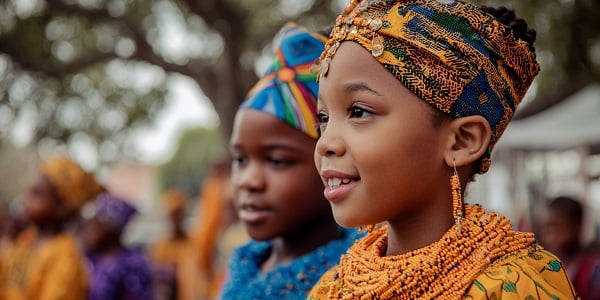
For children growing up in a country still negotiating its identity, Heritage Day is not simply about looking backwards. It is one of the earliest frameworks through which they begin to understand where they belong, how they relate to others and what it means to be part of a society that is both deeply divided in its history and remarkably diverse in its present.
Identity Is Not Inherited. It Is Interpreted
There is a tendency to assume that children simply absorb identity through family, language and environment, yet the reality is more nuanced. Identity is not passively inherited. It is actively interpreted, shaped through what children are told, what they observe and what they are encouraged to question.
Heritage Day introduces children to the idea that identity has layers. It is not fixed to a single narrative or tradition, but exists as a combination of influences, some chosen, others inherited. A child may speak one language at home, another at school and navigate a social environment that blends multiple cultural norms. This complexity is not a contradiction. It is the South African reality.
The lesson, if approached intentionally, is not about defining identity too narrowly, but about allowing children to understand that belonging can be expansive rather than restrictive.
Diversity Becomes Real When It Is Lived, Not Explained
South Africa’s diversity is often described in abstract terms, as something to celebrate or protect, yet for children it is experienced in far more immediate ways. It exists in the classroom, in friendships, in the small differences that shape daily interaction.
Heritage Day offers a rare moment where that diversity is made visible and, importantly, acknowledged. When children see peers wearing traditional clothing, sharing food or speaking openly about their backgrounds, difference shifts from being something unspoken to something recognised.
What matters here is not performance, but context. Without context, culture risks becoming costume. With context, it becomes understanding.
The Risk of Simplifying Culture for the Sake of Celebration
There is an uncomfortable truth embedded in how Heritage Day is often observed. In an attempt to make culture accessible, it is sometimes simplified to symbols, clothing, food and language fragments that are easy to display but difficult to fully explain.
For children, this can create a surface-level understanding that lacks depth. Culture becomes something to wear for a day rather than something to engage with meaningfully.
The challenge for parents and educators is to move beyond this simplification. To ask not only what we celebrate, but why. To explain the histories, the tensions and the resilience that sit behind cultural identity. Without this, Heritage Day risks becoming a performance rather than a lesson.
Belonging Is One of the First Social Lessons Children Learn
Long before children understand politics or history, they understand belonging. They recognise who is included, who is excluded and where they fit within that dynamic.



Heritage Day plays a subtle but significant role in shaping this understanding. When handled thoughtfully, it reinforces the idea that belonging does not require uniformity. That difference does not exclude. That identity is not a barrier to connection.
This is particularly important in a country where division has historically been enforced. The next generation learns not only from what they are told, but from what they are shown.
Stories Carry More Weight Than Symbols
If there is one element of Heritage Day that has the potential to shift understanding, it is storytelling. Unlike symbols, which can be misinterpreted or reduced, stories carry context, emotion and nuance.
When children hear about family histories, migration, struggle, celebration and change, they begin to understand that heritage is not static. It evolves. It is shaped by people, not preserved in isolation.
More importantly, storytelling creates empathy. It allows children to see beyond their own experience and to recognise that every person carries a narrative worth understanding.
ALSO READ: Sotho Baby Names: Timeless Names Rich in Meaning and Heritage
The Future of Heritage Is Being Formed Now
Perhaps the most important truth about Heritage Day is that it is not only about preservation. It is about formation. The way children understand culture today will influence how it is expressed tomorrow.
This generation is growing up in a world that is more connected, more fluid and more open to reinterpretation than any before it. Their understanding of heritage will not mirror that of their parents or grandparents. It will expand it. The question is whether that expansion will be informed and inclusive, or superficial and disconnected.



Why Heritage Day South Africa 2026 Still Matters
Heritage Day continues to matter because it provides a structured moment for reflection in a country that does not always pause to examine its identity. It invites conversation that might otherwise be avoided. It creates visibility where there might otherwise be silence.
For children, it offers something even more valuable. It introduces the idea that identity is not something to defend, but something to understand. That diversity is not a challenge to overcome, but a reality to engage with.
Frequently Asked Questions
When is Heritage Day South Africa 2026 observed?
Heritage Day is observed on 24 September 2026 and is a public holiday.
Why is Heritage Day important for children?
It helps shape their understanding of identity, belonging and cultural diversity.
How can families approach Heritage Day more meaningfully?
By focusing on storytelling, context and open conversation rather than surface-level celebration.
Does Heritage Day only focus on traditional culture?
No. It includes language, history, values and lived experiences that shape identity.
What is the long term impact of Heritage Day on children?
It influences how they understand themselves, others and the society they are part of.
Conclusion: Moving Beyond Celebration
Heritage Day South Africa 2026 offers more than an opportunity to celebrate. It offers a chance to teach, to question and to deepen understanding. For children, the lessons taken from this day will not come from what is worn or displayed, but from what is explained, explored and remembered. In a country still shaping its identity, that distinction matters.
